AI drone herding · Saudi Arabia

Draw a square.
Find every camel in it.

Raai is the app we want to build. An owner marks an area on the map, small drones under 250 g fly it on their own, and AI puts every camel on the map, with an alert if any of them are heading for a road.

2.24Mcamels in KSA 1
<250 gdrone class
1 squareis all the owner draws
Raai · New surveyDraft
Drag on the map to draw your area. This is the real satellite tile of the KAUST field test near Thuwal.

Area

-km²

Drones

3

Camels found

0
Waiting for an area
The problem

A SAR 50bn herd, watched by one man in a pickup.

Saudi Arabia's camels are valuable and spread across open desert, and they still graze along highways. These are the published numbers.

0M
Camels in KSA (2024)
GASTAT. 29.4% are in Riyadh Region 1
SAR 50bn
Market value
Camel Club estimate. MEWA launched a camel passport in Feb 2026 to build a registry 2
0
Deaths in camel crashes, 1990–2010
+ 5,630 injuries. Ministry of Interior data 4
0
Crashes caused by stray animals in 2025
5 deaths and 26 injuries. ROGA, roads outside cities 3
SAR 1.26bn
Human cost of an average year of camel crashes calc
68 deaths × SAR 9.0M + 282 injuries × SAR 2.3M, using the 1990–2010 average 45
0km
Fenced roads
51 camel crossings. Cutting a fence carries a SAR 50,000 fine, and ROGA has recorded 30+ cuts 36
SAR 12.5
Herder wage per camel per month calc
SAR 2,500 for ~200 head, from a Qassim job ad, Feb 2025 7
700→2,000
SAR/month herders demanded
After 41 bodies were found in the southern deserts within 14 months (Okaz, 2006) 8

Labour is cheap. It isn't reliable.

A herder costs about SAR 150 per camel per year. What a herder can't do is see the whole range, keep watch at night, stay safe in a sandstorm, or be fully trusted with a herd worth hundreds of thousands. Camels worth more than SAR 300,000 were stolen in one Qassim case alone 9.

Collars charge per animal and need signal.

A solar 4G camel collar costs SAR 348 plus SAR 219 a year in data 10. Collaring 200 camels costs SAR 113,400 in the first year calc, and a collar can't report anything where there is no 4G coverage.

Why now

Robots have changed camel culture once already.

For decades, camel races were ridden by children. Small, cheap robot jockeys ended the practice within a few years. Drones can do the same for herding.

BEFORE 2005

Child jockeys

Rights groups estimated that as many as 40,000 boys, some as young as four, rode in races across the Gulf 11.

~40,000
activist estimate across the Gulf
2005 – 2006

Robot jockeys

Qatar commissioned "Kamel", a robot jockey from Swiss firm K-Team that raced at up to 40 km/h. UNICEF said inexpensive robots made the UAE ban workable, and by 2006 there were no more child jockeys on UAE tracks 1112.

1,077
boy jockeys covered by UNICEF's UAE return programme
How it works

One request. The drones handle the rest.

The owner doesn't fly anything. They make one simple request in the app, and the system plans the flight, flies it and reports back.

STEP 01

Draw a square

Mark your grazing area on the map, or ask in plain words: "Where are my camels near Thuwal?"

STEP 02

Drones fly themselves

The area is split into strips, one per drone. Each drone flies its lawn-mower pattern, keeps clear of the others and returns home.

STEP 03

AI maps every camel

Detection finds each animal, and positioning converts pixels to GPS coordinates. You get a count, a map and alerts for camels near a road.

Small drones

The hardware is cheap. The value is in the algorithm.

Consumer drones under 250 g are mass-produced, cheap and light, and they sit in the lowest-risk regulatory class. The value of the product is in the AI that tells camels apart from rocks at altitude.

Tracking a 200-camel herd, first year

Each figure is a retail price from a Saudi listing. The arithmetic is ours calc
GPS collars on every camel
200 × (SAR 348 device + SAR 219 data) 10
SAR 113,400
Three sub-250 g drones
3 × SAR 5,444 (DJI Mini 4 Pro, Saudi retail) 13
SAR 16,332
One sub-250 g droneSAR 5,444

The drone cost stays the same as the herd grows. The collar cost grows with every camel. These figures leave out software, operations and spare batteries.

250

Under 250 g

Third-party guides to GACA rules say drones under 250 g generally need no registration 14. They weigh about as much as a phone, so the impact if one falls is small.

0

Nothing on the camel

No collar to fit, charge or lose. A camel enters the count simply by appearing in the camera's view.

AI

The algorithm is the product

The drones are off-the-shelf hardware. The core of the product is a detector trained on a dedicated aerial camel dataset, plus monocular positioning that converts pixels to GPS without extra sensors 15.

1→N

Add drones, not staff

The same app works with one drone or a swarm. More drones means a larger square in the same time.

Proof it works

Already tested in the field.

This builds on the KAUST "Eyes in the Sky" work: a civilian drone with a single camera detected camels and plotted them on a map near Thuwal. Flight tests and a flight control center are in progress.

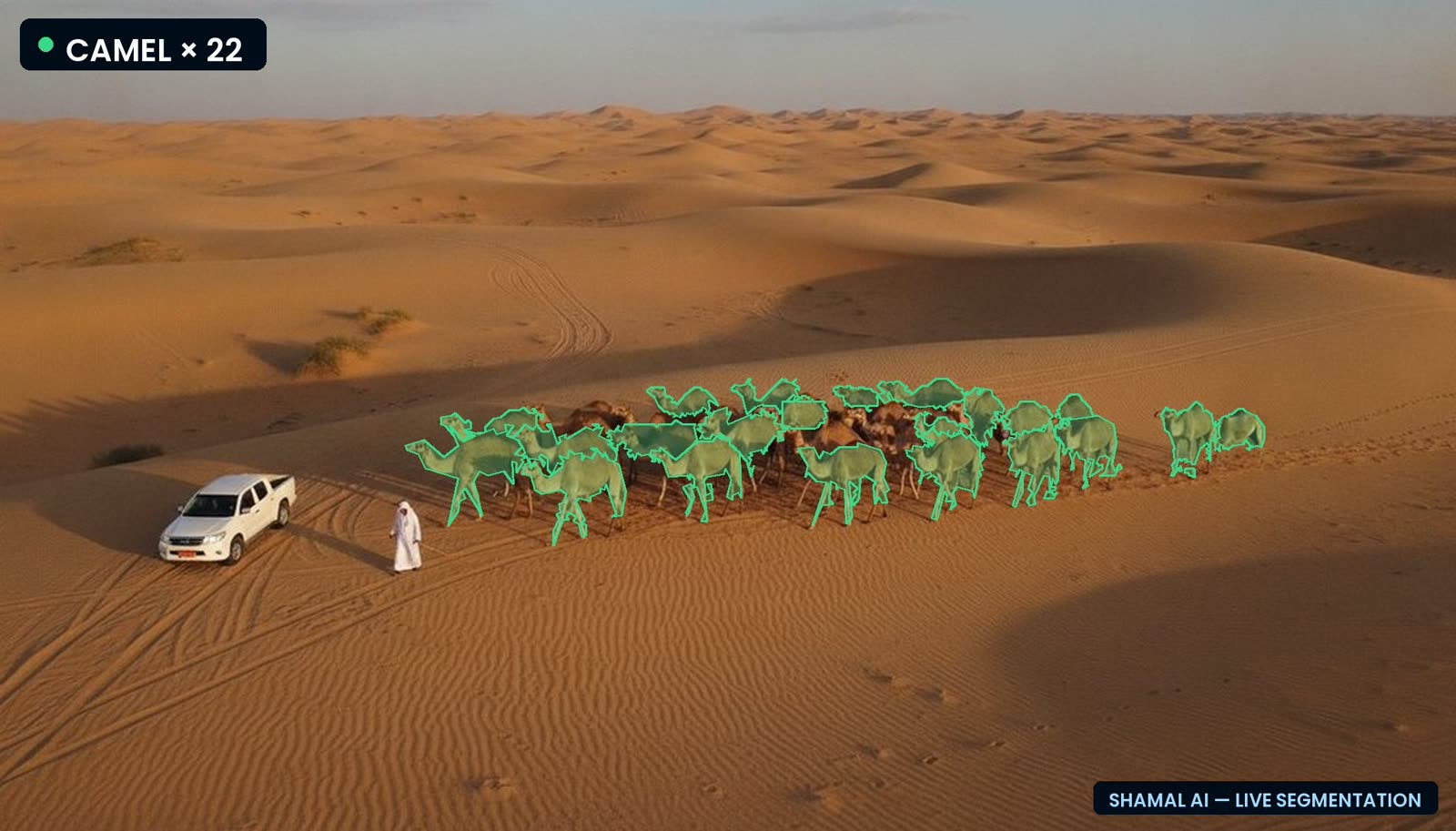
AI segmentation counting 22 camels from a drone view
AI segmentation: 22 camels counted in one frame
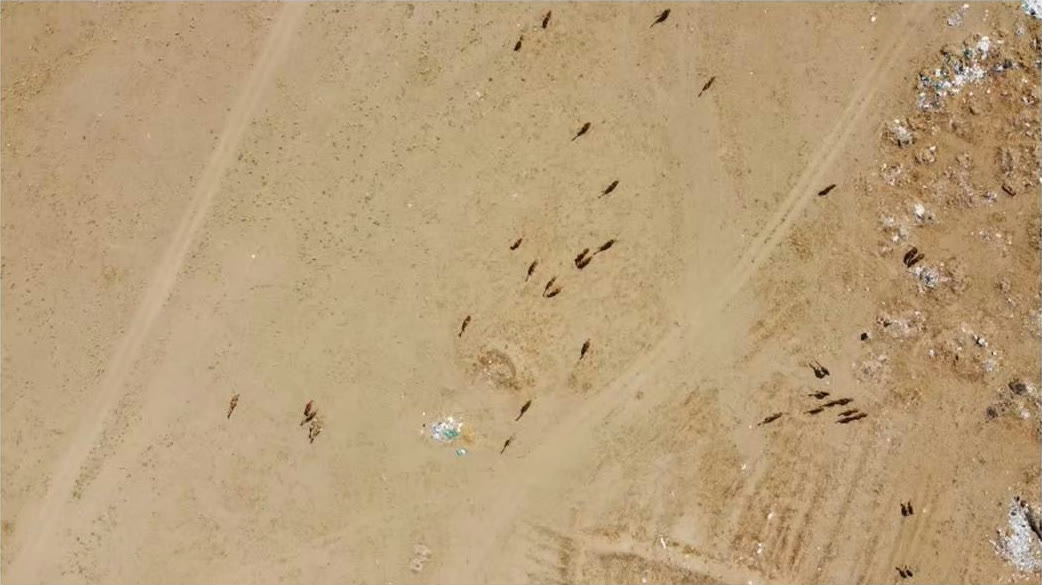
Drone view of a camel herd during KAUST field test
Field test, drone view
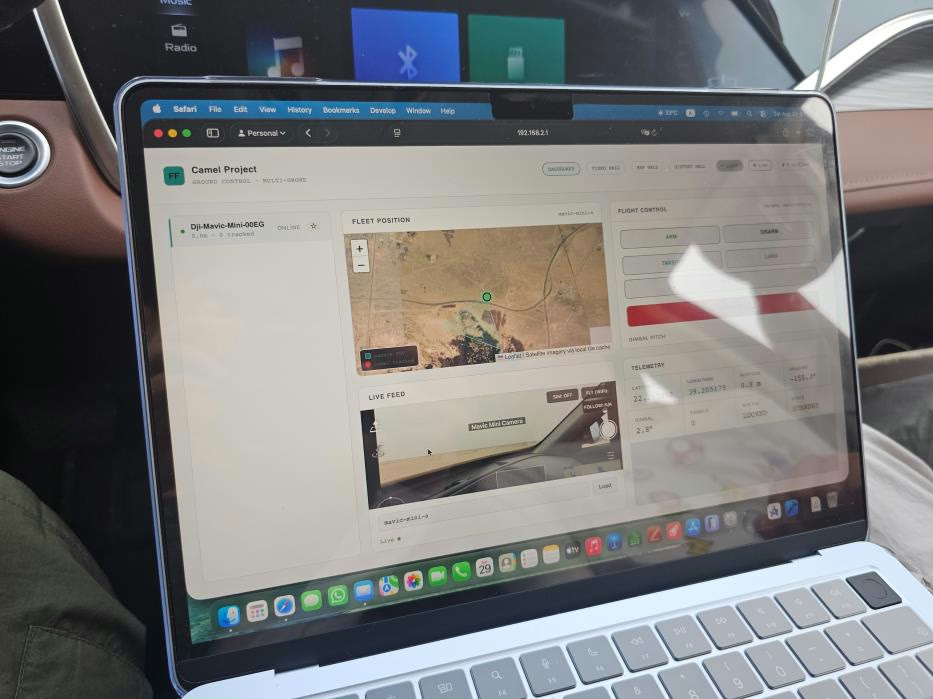
Flight control center running on a laptop in the field
Flight control center, in testing
Camera frame→Tiny-object camel detector→Pixel → GPS (monocular + telemetry)→Map + track→Road / geofence alert
Scalability

Camels first. Then everything that gets lost in the desert.

The workflow of drawing a square, flying it and finding what's there doesn't depend on the target. To support a new target, we train a new detector. The app and drones stay the same.

Phase 1 · now
2.24M

Camels

Herd counts, finding lost camels and road alerts. GASTAT 2024 1

Phase 2
29.3M

Sheep & goats

22M sheep + 7.3M goats, the same pattern on smaller targets. GASTAT 2024 1

Phase 3
1,531

Search & rescue

Calls about stuck vehicles that the rescue group Enjad handled in just 30 days. A missing person is just another target 16

Phase 4
3,056 km

Road corridors

Patrolling fenced highways at dusk, the hours when camel crashes cluster 46

Eyes open

We know the challenges. We still think this is big.

Each of these is a known engineering or regulatory problem, and none of them is a reason to stop.

Autonomous flight approval

High

Flying without a pilot beyond visual line of sight needs GACA approval, whatever the drone weighs. The pilot phase stays in line of sight.

Night

High

Crashes cluster at dusk and before dawn 4. Night detection needs a thermal camera, which may push a drone over 250 g.

Heat, wind, dust

Medium

Small drones lose flight time in heat and wind. Flights are scheduled for cooler hours, with a ground station for battery swaps.

Tiny objects

Medium

From altitude, camels are only a few pixels across and all the same colour. The custom dataset and detector are built to handle exactly that.

No signal in the desert

Medium

Inference runs on the edge, on the controller or a phone, and the results sync when a connection is available.

Missing baseline data

Solvable

Nobody publishes how many camels are lost or stolen each year. The pilot will measure it.

What we want to build

One owner. One square. One month.

A focused pilot that proves the app works and collects the numbers nobody has yet: how many camels go missing, and how close they come to the road.

1camel owner and herd, with their own square on the map
3drones under 250 g, flown in line of sight during the pilot
30days of counts, tracks and road alerts, compared against the herder's own count
Try the app again
Sources (16). Every figure on this page links to one of these.
  1. GASTAT, Livestock Statistics 2024 release: camels 2.24M (+1%), Riyadh 29.4%, sheep 22M+, goats ~7.3M. stats.gov.sa/en/w/news/119
  2. bne IntelliNews, "Saudi Arabia introduces camel passports to regulate $13bn market", Feb 2026 (SAR 50bn market value, Camel Club). intellinews.com
  3. Al-Watan, ROGA 2025: 426 crashes caused by stray animals, 5 deaths, 26 injuries; 51 camel crossings; SAR 50,000 fence-cutting fine (also Al-Mowaten, Jan 2026). alwatan.com.sa/article/1180631
  4. Al-Shammari & Neal-Sturgess, AGJSR 34 (2016) 43–56: MoI data 1990–2010, 1,360 deaths and 5,630 injuries; crashes mostly in the evening and early morning; owners cutting fences. agjsr.agu.edu.bh
  5. Spencer, Alluhidan, Alghnam et al., Frontiers in Public Health, 23 Sep 2025: KSA road crashes cost SAR 137.6bn (3.3% of GDP); SAR 9.0M per death, SAR 2.3M per injury. frontiersin.org
  6. Al-Watan, ROGA on fence violations: 30+ cases; 3,056 km of fenced roads. alwatan.com.sa/article/1175319
  7. Job ad, camel herder, Ar Rass, Qassim, 10 Feb 2025: SAR 2,500 a month for ~200 head. alwzifa.com/78440
  8. Okaz, 28 May 2006: herder wages in Ranya, Tathleeth and Wadi al-Dawasir rose from SAR 700 to 2,000 after 41 bodies were found in 14 months. okaz.com.sa/article/19673
  9. Gulf News: Qassim Police arrest 7 over theft of camels worth SAR 300,000+ (updated Nov 2020). gulfnews.com
  10. BSTA, Zard S28L solar 4G camel tracker: SAR 347.89; M2M data plan SAR 219 a year (checked Oct 2026). bsta.sa
  11. Swissinfo, "Robots jockey for position in camel races" (K-Team "Kamel", 40 km/h; ~40,000 boy jockeys per rights groups). swissinfo.ch
  12. Al Jazeera, "UNICEF: UAE ends child jockey use", 18 Dec 2006 (1,077 boys; no child jockeys left on UAE tracks). aljazeera.com
  13. Desertcart Saudi Arabia, DJI Mini 4 Pro (<249 g): SAR 5,444, duties included, updated May 2026. desertcart.com.sa
  14. Third-party guides to Saudi drone rules (sub-250 g registration). These are not GACA text, so confirm with GACA. drone-laws.com · 9tenthsco.com
  15. Shihada et al., "Eyes In The Sky: AI-based Camel Identification and Tracking Using Drones" (KAUST seminar deck, Oct 2026); Arab News, 9 Jul 2026. arabnews.com/node/2650315
  16. Ajel, 4 Nov 2022: the rescue group Enjad handled 1,531 calls about stuck vehicles in 30 days; a camel herder was lost for 3 days in a sandstorm. ajel.sa